


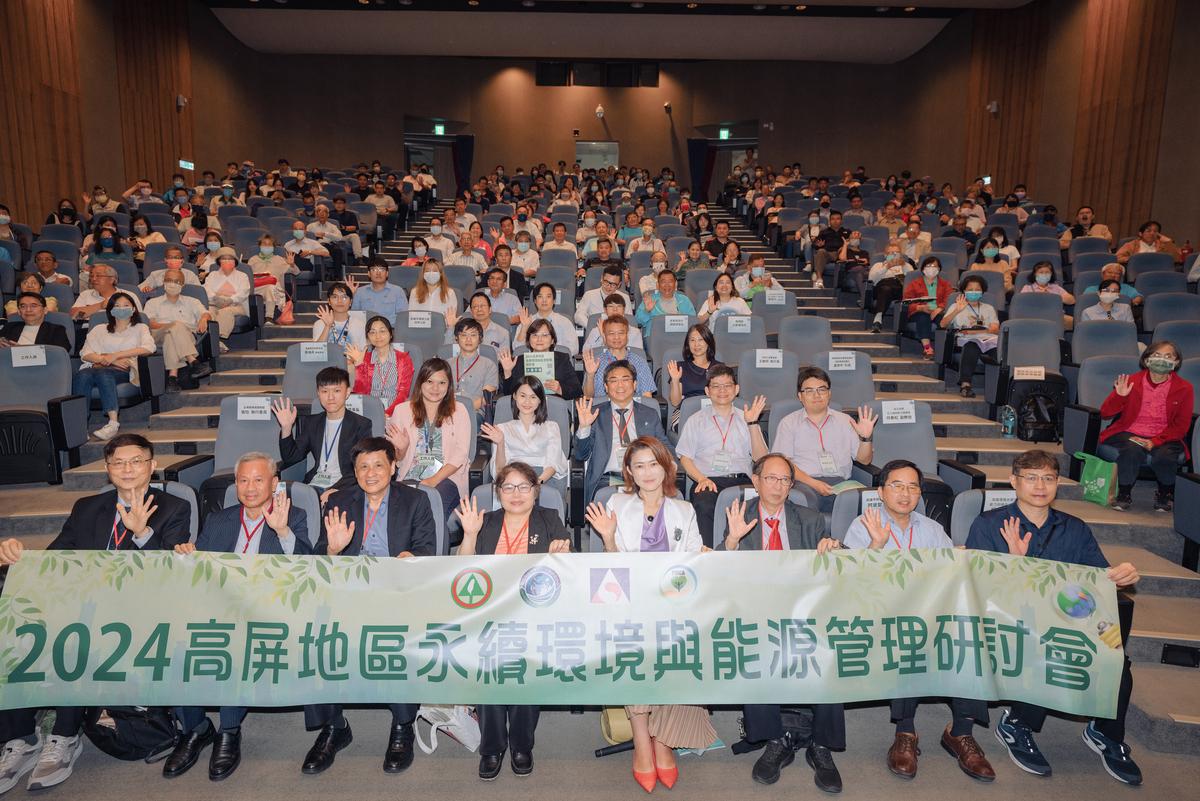
To address the 2050 net-zero emissions target and mitigate the impacts of climate change on the environment, society, and human well-being, National Sun Yat-sen University's (NSYSU) Aerosol Science Research Center (ASRC), in collaboration with the Taiwan Environmental Protection Union, the National Science and Technology Museum (NSTM), and the Taiwan PM2.5 Monitoring and Control Industry Development Association, hosted the "2024 Kaohsiung-Pingtung Symposium on Sustainable Environment and Energy Management" today (19th) at NSTM. The symposium gathered more than 350 participants from academia, industry, government, research institutions, and civil society. Through five sessions—renewable energy development, resource circulation policy, air quality improvement, environmental education and civic advocacy, and sustainable environmental governance—experts examined Taiwan's current progress and challenges on the path toward 2050 net-zero transition, aiming to identify solutions and collectively explore a sustainable future for Earth's ecosystems.
Professor Chia C. Wang, Director of the ASRC at NSYSU, emphasized that air quality not only affects global climate and ecosystems but also public health, making it closely tied to the United Nations' 17 Sustainable Development Goals (SDGs). She noted that NSYSU's ASRC is the first in Taiwan to actively respond to the global Inner Development Goals (IDG) movement, advocating that achieving the SDGs requires a transformation of people's inner values and thinking patterns. This includes re-examining and becoming aware of one's connections with the environment, with others, and with all living beings, while cultivating essential inner skills such as an inner compass, critical thinking, long-term vision, empathy and compassion, openness and learning mindset, and co-creation. In her keynote, Professor Wang also shared the current global state of aerosol science and discussed how implementing both SDGs and IDGs can help build a sustainable home for humanity.
The symposium also showcased the research achievements of the AIR HoPE Academic-Industry Research Hub of People and Earth—a collaboration between NSYSU's ASRC and China Steel Corporation—including novel air quality measurement methods, air pollution reduction equipment, and materials designed to help industries with emission-reduction needs achieve cleaner air. In addition, the ASRC presented innovative educational materials for improving air quality and air purification, such as the globally translated (20 languages) science outreach booklet "The Quest of the Virosols" and the decision-making board game "Air, Don't Cry: Fight for Clean Air."
Kuang-Liang Yeh, President of the Taiwan Environmental Protection Union (TEPU), remarked that sustainability and energy transition have long been the Union's core concerns. TEPU has consistently promoted environmental movements to protect Taiwan's ecology, reduce pollution and destruction, and work toward a nuclear-free homeland where citizens can enjoy a safe, healthy, comfortable, and sustainable environment. In recent years, TEPU has organized the "Southern Taiwan Sustainable Environment Symposium" and the "Northern Taiwan Sustainable Environment Symposium" (2021), as well as the "Hualien-Taitung Regional Sustainable Development Symposium" (2022). Each year, it also conducts the "Local Government Sustainable Environmental Governance Assessment" and "Workshops on Climate Change and Net-Zero Environmental Education," actively fostering dialogue across society to embed sustainability thinking into everyday life. Yeh expressed hope that this symposium would again address the current status and challenges of achieving the 2050 net-zero transition, especially in renewable energy management and air quality improvement, while strengthening cooperation among central and local governments, academia, industry, and civil society.
Hsiu-Feng Li, Director of the National Science and Technology Museum, expressed her hope that the museum can, through education, exhibitions, and hands-on experiences, serve as a platform for dialogue and collaboration on sustainability issues, fulfilling its social responsibility in advancing sustainable environmental development. Recently, the museum launched the special exhibition "Climate Change, We Change—Rainfall", which explains climate change and global warming. It highlights questions such as: Why does Taiwan, with annual rainfall three times the global average, still face water shortages? How should the country cope with sudden torrential rains and the need to store water, alternating between floods and droughts? These pressing issues are explored in the exhibition, and the public is warmly invited to visit.
Yi-Cyun Dai, Secretary-General of the PM2.5 Control Association, noted that many industries require PM2.5 monitoring, control, and emission reduction. He welcomed the opportunity provided by this symposium for association members from various sectors to learn the latest scientific knowledge on air quality management and PM2.5 monitoring and reduction, with the hope that these practices can be applied in their respective industries in the future.
Speakers at the symposium included Shun-Chin Chang, Director-General of the Department of Atmosphere Environment at Taiwan's Ministry of Environment; Ying-Ying Lai, Director-General of the Resource Circulation Administration; Jen-Jen Huang, Supervisor at the Chiayi County Education Department; representatives from the Environmental Protection Bureaus of Kaohsiung City and Pingtung County; Kuei-Kuang Chen, Chairman of Sunny Rich Group; and Min-Ling Wang, Chair of the Taiwan Ocean Energy Development Association and Chair of the Citizen of the Earth Taiwan.
(1).jpg)
.jpg)
.jpg)
.jpg)