


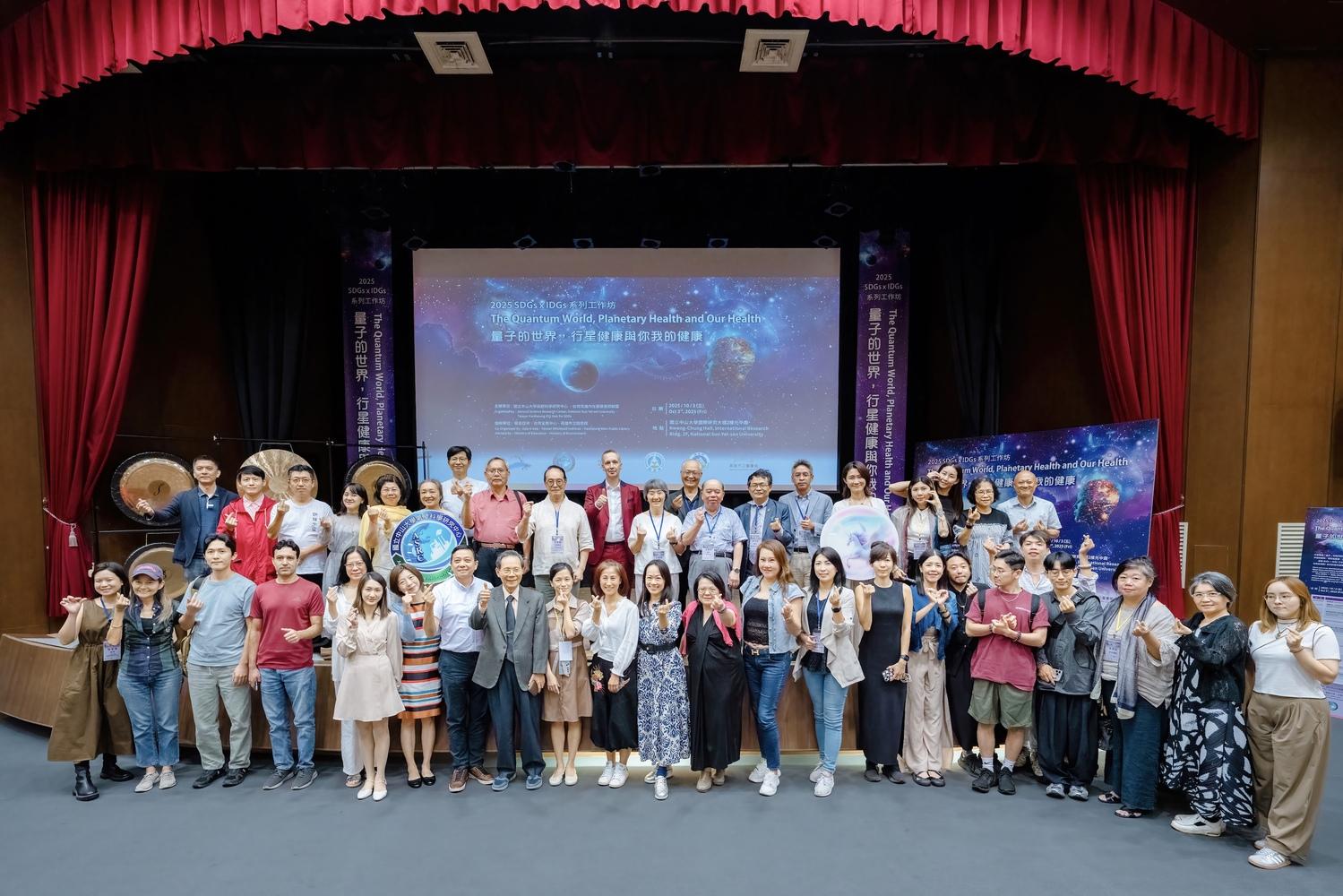
Could the act of human breathing, Earth's climate, and even the operation of the cosmos all follow the same quantum laws? Einstein once said that humans, limited by their senses, mistakenly perceive themselves as separate from the world. In truth, humanity is not merely a resident of Earth but an integral part of the planet's "health system." To explore this intricate link between the micro and macro realms, the Aerosol Science Research Center (ASRC) of National Sun Yat-sen University (NSYSU) hosted the international workshop "The Quantum World: Planetary Health and Human Well-being." The event gathered over 230 participants from 26 countries in both virtual and in-person formats, inviting them to re-envision the profound interconnection between humans and the environment through the lens of quantum mechanics.
Professor Chia C. Wang, Director of the ASRC and Professor of Chemistry at NSYSU, explained that while quantum mechanics is often regarded as a science of the microscopic world, emerging studies in quantum biology reveal that many of the mechanisms by which humans exchange information with the environment—such as gas exchange through the respiratory system and sensory detection of light, sound vibrations, scent, and mechanical forces—are manifestations of quantum phenomena operating at macroscopic scales. Deeper understanding of these processes, Wang noted, reveals that what we perceive as the external environment is, in fact, an extension of ourselves. Recognizing this unity underscores that the health of Mother Earth and that of humanity are intricately and inseparably linked.
Wang referenced the groundbreaking discoveries of quantum physicists such as Max Planck's quantization of energy, the wave–particle duality, Schrödinger's wave equation, de Broglie's matter waves, and Heisenberg's uncertainty principle—each illustrating the wave-like and energetic nature of matter. She further drew upon advances in quantum biology to explain the quantum mechanisms underlying human perception and respiration. Visiting Professor Hsun-Ling Bai from NSYSU's ASRC then posed three thought-provoking questions—"What is consciousness?", "Can quantum mechanics explain it?", and "Does consciousness co-create reality?"—guiding participants to reflect on the nature of consciousness and the possible role of quantum phenomena in shaping collective experience.
The workshop opened with welcome remarks from Caroline Stiernstedt Sahlborn, Chair of the international NGO Inner Development Goals (IDG), and Mila Aliana from the IDG headquarters. Academia Sinica Academician and NSYSU ASRC Honorary Chair Professor Pao-Kuan Wang spoke on the intrinsic nature of Earth's climate system and planetary health, analyzing the mechanisms of extreme weather caused by global warming and highlighting aerosols' pivotal role. Marcus Schmieke, founder of Germany's TimeWaver technology, also delivered a keynote emphasizing the quantum nature of the universe and the omnipresence of quantum information.
The event featured interdisciplinary speakers spanning chemistry, atmospheric and climate science, cognitive psychology, neuroscience, and holistic medicine. Professor Po-Jang Brown Hsieh, Department of Psychology at National Taiwan University and MOE Yushan Young Scholar, shared the latest insights in brain and consciousness studies, exploring how cognitive processes construct human perception and how people inhabit brain-created "virtual realities." Dr. Kun-Hsing Lee, Neurosurgeon at Kaohsiung Medical University Chung-Ho Memorial Hospital, connected astronomy and medicine to reflect on life and health, explaining the mythological origins of many medical terms from Greek and Roman traditions. Professor Lucian Y. J. Leu, Director of the Wholeself Institute, shared his personal journey of recovery from cancer, underscoring the importance of mind–body–spirit health and aligning traditional Eastern medicine's holistic philosophy with the modern One Health framework. Co-organizers included the Taiwan Kaohsiung IDG Hub, Goodness Asia, the Wholeself Institute, and the Kaohsiung Public Library.
.jpg)
.jpg)
.jpg)
.jpg)
.jpg)
.jpg)
.jpg)
.jpg)
.jpg)
.jpg)
.jpg)